Short answer: an AI chatbot answers common questions instantly, at any hour, without staff, while live chat connects visitors to a real person who can handle complex or sensitive questions. For most small businesses the best choice is both: a chatbot that handles routine questions and bookings, and hands the conversation to a person when it needs judgment, with the full chat history attached.
What is the difference between a chatbot and live chat?
| AI chatbot | Live chat | |
|---|---|---|
| Who replies | AI trained on your information | A member of your team |
| Availability | 24/7 | When staff are online |
| Speed | Instant | Depends on who is free |
| Best for | FAQs, bookings, lead capture | Complex questions, complaints, sales conversations |
| Running cost | Software and usage fees | Staff time plus software |
| Risk | Wrong answers if poorly set up | Slow replies if understaffed |
When is a chatbot the better choice?
- You get many repeat questions about hours, services, policies or prices you publish.
- Most inquiries come in evenings and weekends.
- You want to capture leads and bookings while you are busy.
- You do not have someone free to watch a chat window all day.
See our guide to automating customer service for more examples.
When is live chat the better choice?
- Your sales involve detailed questions and personal advice.
- Customers often need help with problems that are different every time.
- You sell high-value services where a human conversation builds trust.
- Someone on your team is available during the hours most visitors arrive.
Why do many businesses combine both?
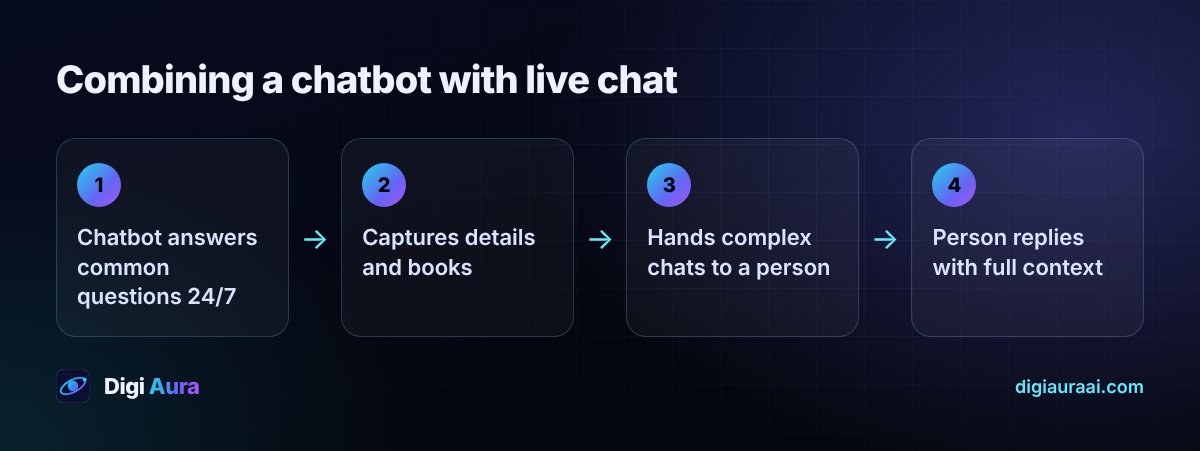
A combined setup lets the chatbot handle the routine work and pass anything complex to a person. The key is a smooth handoff: the person should see the whole conversation, so the customer never has to repeat themselves. Outside business hours, the chatbot can take details and promise a reply. Our guide to AI agents vs chatbots explains how agents can go further, for example by updating your CRM.
How do you make a chatbot accurate and trustworthy?
- Train it only on your approved information.
- Tell it to say "I don't know" and offer a person, rather than guess.
- Be open that customers are chatting with an AI assistant.
- Review a sample of conversations every week and improve the answers.
- Never let it handle payments, passwords or sensitive personal data in the chat.
Which should your small business choose?
Start with a chatbot for common questions and lead capture if you are short on time, and add live chat handoff for the moments that need a person. Our AI chatbot development service builds chatbots trained on your business with a human handoff, and our AI receptionist service does the same for phone calls. You can also try the chat assistant on our own website to see one in action.
Frequently asked questions
Is a chatbot better than live chat?
Neither is better for everything. Chatbots win on speed and availability for routine questions; live chat wins on complex or sensitive conversations. Many businesses use both.
Can a chatbot hand over to a real person?
Yes. A good setup passes the conversation to a team member, with the full history, when the chatbot cannot help or the customer asks for a person.
Are AI chatbots expensive for small businesses?
Costs vary with features and usage. Many businesses find a chatbot costs less than staffing live chat for the same hours.
Do customers like chatbots?
Customers mainly want fast, accurate answers. They are usually happy with a chatbot that answers well and makes it easy to reach a person.
What should a small business chatbot not do?
It should not give legal, medical or financial advice, take payment details in chat, or handle complaints without a person.
Want a chatbot that knows your business and hands over smoothly? Book an AI consultation.