Short answer: an AI receptionist answers your business phone line, turns what the caller says into text, works out what they need, and replies with a natural-sounding voice. It answers questions from information you approve, books appointments or takes messages, transfers urgent calls to a person, and sends your team a summary of each call.
If your business misses calls while you are busy with customers, or after hours, an AI receptionist can make sure every caller gets a helpful answer.
What is an AI receptionist?

An AI receptionist is a voice AI system that handles incoming phone calls for a business. Unlike an old phone menu ("press 1 for sales"), it holds a normal conversation. Unlike a human answering service, it is available every hour of every day. For the wider technology behind it, see our guide to AI voice agents for small business.
Our AI receptionist for small business page covers what we build and for whom. For where it fits among other AI tools, see how to use AI in your business.
How does an AI receptionist work, step by step?
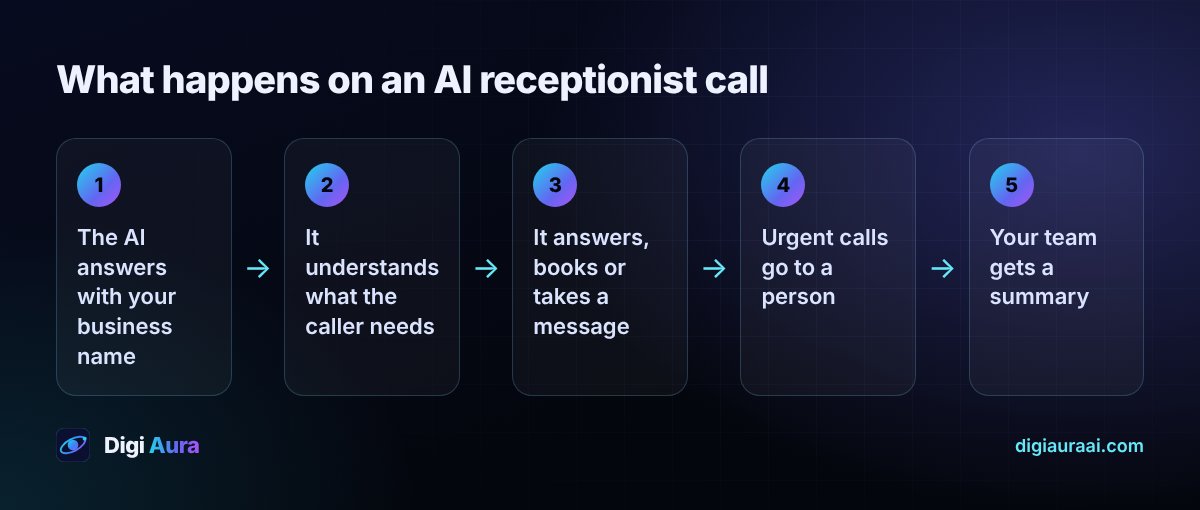
- The call arrives. Your number forwards calls to the AI receptionist, either all the time, after hours, or when nobody picks up.
- Speech becomes text. Speech recognition turns the caller's words into text in real time.
- The AI works out what is needed. A language model reads the text and decides whether the caller has a question, wants to book, or needs a person.
- It replies with a voice. The answer is turned back into natural-sounding speech.
- It takes action. It can check your calendar and book a slot, take a message, or transfer the call.
- Your team gets a summary. After the call, you receive the caller's details, what they wanted and what was agreed.
In a good setup, replies come quickly enough that the conversation feels natural.
What can an AI receptionist do for a small business?
- Answer questions about hours, services, prices and location from your approved information.
- Book, confirm and reschedule appointments in your calendar.
- Take detailed messages and callback requests.
- Transfer urgent calls to your on-call number.
- Qualify new leads with a few simple questions.
It is especially useful for dental and medical offices, salons, contractors, law firms and real estate agents. See our industry pages for examples.
What can't an AI receptionist do?
Be clear about the limits:
- It should not give medical, legal or financial advice.
- It can misunderstand strong accents, poor phone lines or very unusual requests, so a hand-off to a person matters.
- It only knows what you tell it. Out-of-date prices or policies lead to wrong answers.
- It cannot handle emotional or complex conversations as well as a skilled person.
Callers should be told they are speaking with an AI assistant, and it should always be easy to reach a human.
What should you check before setting one up?
- Your call patterns. When do you miss the most calls? After hours, lunch, busy mornings?
- Your information. Write down clear answers to the 10 to 20 questions callers ask most.
- Your calendar and tools. The receptionist is most useful when it can book directly into your system.
- Escalation rules. Decide which calls must go to a person right away.
- Privacy. Ask where call recordings and transcripts are stored and who can access them.
- Cost. See how much an AI receptionist costs for the pricing models and extra fees to ask about.
AI receptionist vs chatbot: what is the difference?
An AI receptionist talks on the phone. A chatbot types on your website or in messaging apps. Both can use the same approved information, and many businesses use both. Read more in AI agents vs chatbots, our guide to automating customer service and the best AI tools for small business.
Frequently asked questions
How does an AI receptionist answer calls?
Your phone number forwards calls to the AI system. It converts the caller's speech to text, decides how to respond using your approved information, and replies with a natural voice.
Can an AI receptionist book appointments?
Yes, when it is connected to your calendar or booking system. It can check free slots, book, confirm and reschedule. See AI appointment scheduling for how to set it up.
Will callers know they are talking to an AI?
They should. Being open builds trust, and it should always be easy for the caller to ask for a person.
What happens if the AI receptionist cannot answer?
A good setup takes a message or transfers the call to a person, and sends your team a summary so nothing gets lost.
Is an AI receptionist better than a human receptionist?
It is not a full replacement. It is best for routine calls and after-hours coverage, while people handle complex or sensitive conversations.
Missing calls costs you customers. Book an AI consultation to see whether an AI receptionist fits your business.