Short answer: the best way to use AI in a small business is to start with one repetitive task that costs real time or money, such as answering common questions, following up leads or writing marketing drafts, and use AI to speed it up while a person checks the results. Once that works, connect AI to your other tools so whole workflows run automatically.
This is our main guide to AI for business. Each section links to a more detailed article.
Where can AI help a small business most?

AI is strongest at work that involves reading, writing, sorting and summarizing. In most small businesses, that means:
- Customer service: answering questions, booking appointments, taking messages.
- Sales: following up inquiries quickly and keeping the CRM up to date.
- Marketing: drafting posts, emails, blog articles and graphics.
- Admin: turning emails, forms and documents into records, quotes and reports.
- Decisions: summarizing numbers and highlighting what changed.
How can you use AI in customer service?
Use a website chatbot for common questions and an AI receptionist for phone calls, both trained on your approved answers, with an easy hand-off to a person.
Read more: Automating customer service with AI and How does an AI receptionist work?
How can you use AI in sales and lead follow-up?
AI can reply to new inquiries within minutes, ask a few qualifying questions, add the lead to your CRM and remind your team to follow up. An AI agent can prepare personal follow-ups for you to approve.
Read more: AI agents vs chatbots and our custom AI agents page.
How can you use AI in marketing?
AI assistants can draft social posts, newsletters and website copy, and design tools can create graphics in your brand style. Always edit drafts so they sound like you and are accurate.
Read more: AI content creation services and social media management for small business.
How can you use AI for admin and operations?
AI automation can pull details from forms, emails and PDFs, create draft quotes and invoices, and build weekly reports, which saves the copy-paste work that fills many people's days.
Read more: What is AI automation? and What is an AI automation agency?
Which AI tools should a small business start with?
Most businesses need one general AI assistant plus a few tools for specific jobs. Choose by the task you want to fix and by the apps you already use.
Read more: The best AI tools for small business and Claude AI for small business.
How do you start using AI in your business?
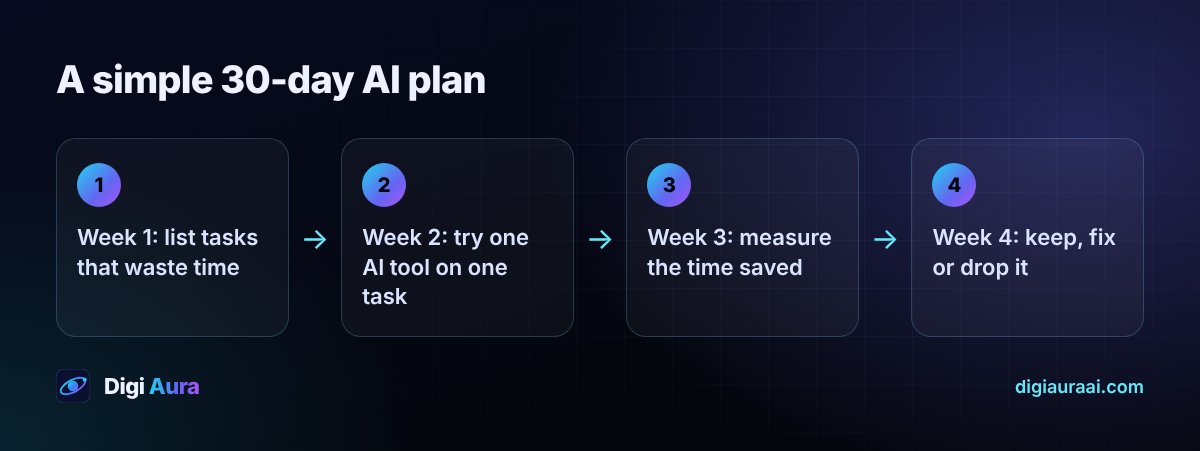
A simple 30-day plan:
- Week 1: list the tasks that waste the most time. Ask your team too.
- Week 2: pick one task and try one AI tool on it.
- Week 3: measure the result. How much time did it save? Were there mistakes?
- Week 4: keep it, fix it, or drop it, then pick the next task.
To turn this into a longer-term plan, read our AI business strategy guide for small businesses.
What are the risks of using AI in business?
- Wrong answers. AI can sound confident and still be wrong. Check customer-facing output.
- Data privacy. Know what each tool does with your data, and avoid sharing sensitive information with tools that are not approved for it. A short AI policy helps your team follow the same rules.
- Over-automation. Keep people involved in money, legal, medical and sensitive conversations.
- Tool sprawl. Too many disconnected tools create new work instead of saving it.
When should you get help with AI?
Doing it yourself works for simple uses like writing help. Outside help is worth it when AI needs to connect to your other systems, touches customers or sensitive data, or when you simply do not have the time. Read What does an AI consultant do? to see what that involves.
Frequently asked questions
How can a small business use AI?
Start with one repetitive task, such as answering common questions, following up leads or drafting marketing content. Use AI to speed it up, check the results, then expand to connected workflows.
What is the easiest way to start using AI in business?
Use a general AI assistant for writing and summarizing tasks you already do every week. It needs no setup and shows quickly where AI helps.
Is AI expensive for small businesses?
It does not have to be. Many tools have free or low-cost plans. Costs rise when AI is connected to several systems, which is where it also saves the most time.
Will AI replace my employees?
For most small businesses, AI takes over repetitive tasks rather than whole jobs, so staff can spend more time with customers.
How do I keep my business data safe when using AI?
Use business plans with clear data terms where possible, share only what each task needs, set team rules, and review each tool's privacy settings.
Want a clear plan for AI in your business? Book an AI consultation and we will help you pick the right first steps.