Short answer: a good AI business strategy for a small business is short and practical. Choose two or three business goals, list the tasks that slow you down, pick one first project that supports a goal, set simple rules for data and approvals, train your team, and measure the results before you expand.
The aim is not to "use AI everywhere." It is to use AI where it clearly saves time, wins customers or reduces mistakes.
Why does a small business need an AI strategy?

Without a plan, AI use tends to happen in scattered ways: one person uses one tool, someone else uses another, and nobody knows what customer data has been shared or whether any of it saves time. A simple strategy gives you:
- Focus on the problems that matter most.
- Safety, with clear rules about data and approvals.
- Proof, because you measure results before spending more.
What should an AI business strategy include?
| Section | What to write | Example |
|---|---|---|
| Goals | 2-3 business outcomes | Reply to every lead within an hour |
| Opportunities | Tasks that are slow, repetitive or error-prone | Copying form leads into the CRM |
| First project | One small, measurable project | Automated lead replies and CRM entry |
| Tools | What you already have and what you need | Existing email, CRM and an automation platform |
| Data rules | What can and cannot go into AI tools | No card numbers or passwords, ever |
| People | Who owns it and who approves outputs | Office manager reviews AI drafts weekly |
| Measures | How you will know it works | Average reply time, hours saved |
How do you build an AI strategy step by step?
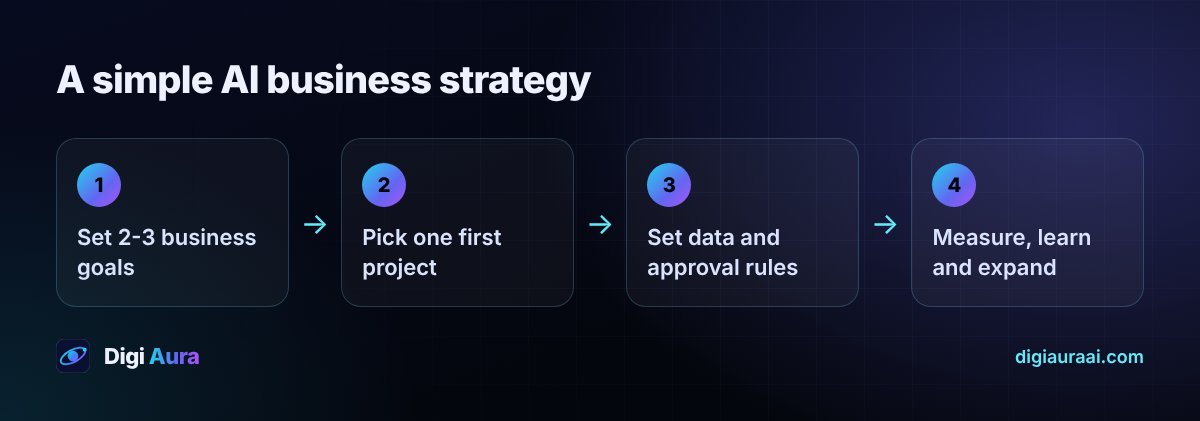
- Set two or three business goals. Start from the business, not the technology: more leads, faster replies, fewer missed calls, less admin.
- List your time-consuming tasks. Ask your team where the hours go each week. Our guide to what AI automation is shows the kinds of tasks AI handles well.
- Pick one first project. Choose something small, common and easy to measure, such as automated lead follow-up or automating customer service for common questions.
- Choose tools. Start with what you already pay for. See the best AI tools for small business.
- Set data and approval rules. Decide what information may go into AI tools and which outputs a person must approve. Our guide on how to write an AI policy includes a one-page outline.
- Train your team. A short session on good prompts, checking outputs and the data rules goes a long way.
- Measure for 30 to 60 days, then decide whether to expand, change or stop.
What are good first AI projects for a small business?
- Answering common customer questions on your website.
- Replying to new leads quickly and adding them to your CRM.
- Answering calls and booking appointments after hours.
- Drafting social media posts and emails for review.
- Summarizing meetings, documents and reviews.
- Bringing key numbers into one place with an AI dashboard.
What mistakes should you avoid?
- Starting with the most complex process in the business.
- Buying several AI tools at once before testing one.
- Letting AI send messages to customers with no human review at the start.
- Not measuring anything, so you cannot tell if it worked.
- Forgetting the ongoing costs. Our guide to how much AI consulting costs lists the running costs to plan for.
Should you get help with your AI strategy?
Many owners can write a first strategy themselves using the steps above. An outside view helps when you are not sure where to start, when AI needs to connect to several systems, or when customer data is involved. Our AI consulting services cover strategy and planning, and our guide to what an AI consultant does explains the process. For a broader introduction, read how to use AI in your business.
Frequently asked questions
What is an AI business strategy?
It is a short plan that says which business goals AI will support, which projects come first, which tools you will use, what rules apply to data and approvals, and how you will measure results.
How long should a small business AI strategy be?
One or two pages is enough for most small businesses. A clear, short plan that people follow beats a long report nobody reads.
What is the first step in an AI strategy?
Choose the business goals first. Then look for slow or repetitive tasks that, if improved, would move those goals forward.
How do I measure whether AI is working?
Pick one or two measures before you start, such as hours saved per week, reply time or the number of booked calls, and compare them before and after.
How often should I update my AI strategy?
Review it every few months. AI tools change quickly, and each finished project teaches you what to try next.
Want a clear AI plan for your business? Book an AI consultation and we will build it with you.